

Spruce Budworm Update
Dr. Neil Thompson is an Associate Professor of Forestry at the University of Maine Fort Kent.
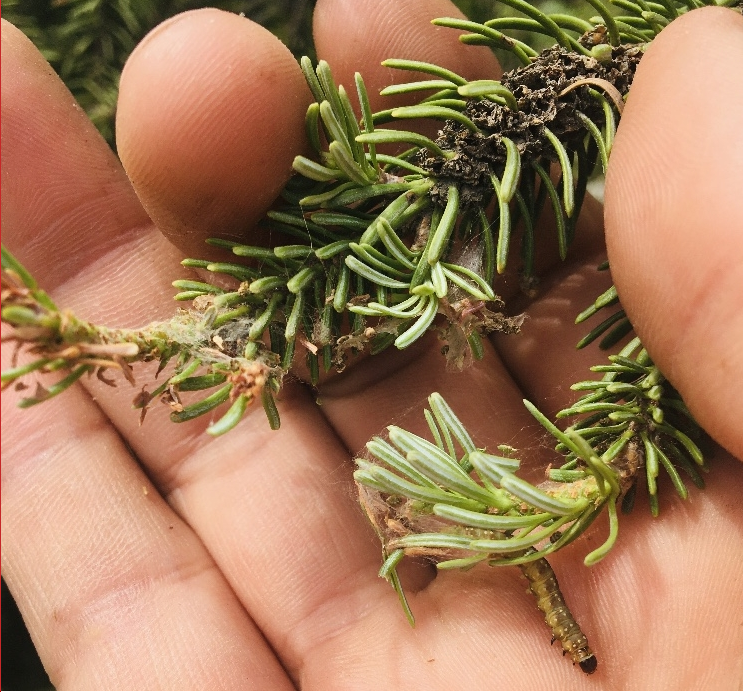
Combined efficacy of the treatment program and the action of natural enemies has been very high in 2026. Immediate effects of tebufenozide applications were apparent in the days following application, continuing for ~2 weeks. Where a Btk block and Tebufenozide block were adjacent near a point with an L2 count of 43, there was no apparent difference between the products two weeks after the applications: both had 1-2 survivors per branch as is generally expected. Dr. Rahimzadeh-Bajgiran and her graduate students have flown remote sensing drones at four sites with Btk/tebufenozide intersections; this will take some time to process but no visible differences were noted on the ground.
Effects of natural enemies were likely enhanced by this year's weather pattern: the cool, rainy period during the L4-L6 feeding window delayed maturation, with every day presenting more opportunities for parasitoids to find their hosts. Treatments early in the feeding season reduced the host availability within the blocks, increasing the rate of parasitism on survivors. A study led by Dr. Mech is in its first of three years investigating this phenomenon: larvae and pupae were sampled weekly at six sites, and their parasitoids are being reared out and identified.
Truly complementary/additive mortality is a cornerstone of EIS and has been particularly stark with the early timing of treatments in these past two years. Treatments have been initiated precisely with the availability of host foliage, and they have been completed quickly. As the effects of the treatment taper off, a wave of parasitism hits the remainder of the population, including within-block survivors, in buffers, and areas near the treatment blocks.
Surveys of the 2026 migration are nearly complete, and evaluation of the 2026-27 overwintering population is just beginning. Maine Forest Service aerial survey flights found no defoliation outside of known areas in the Fish River and St. John valleys. Six automated pheromone traps along the Maine/Quebec border tracked the timing of moth migration flights, and the Maine Forest Service pheromone trap network has tracked the distribution of moths within the state. High counts along the western border between Big 10 and Big 20, and in the Fish River/St. John valleys, suggest strong short-range migration from established populations. High counts at several traps downeast suggest successful long-range flights, in line with long-range migration model outputs. The overwintering population (L2) survey is starting with ~40 sites collected in the first week in the vicinity of pheromone traps with high catches.
Preliminary maps will be available in early September, and models will be refined as additional samples are processed through the end of 2026.

New Spruce Budworm L2 Data
Current data points on the L2 larval numbers of spruce budworm show significant success in the areas treated through the EIS spray program this spring. The Maine Forest Service is currently reaching out to landowners who are interested in future involvement in the program.
Eligible areas in Maine meeting conditions such as spruce budworm populations, forest type, operability and clear ownership boundaries will be considered for inclusion in the 2026 Spruce Budworm Treatment Program. Fill out this form to indicate interest in consideration of the program.
This does not constitute an “Opt In” to the program, just initial interest. It is most likely that operations in 2026 will be concentrated in far northern Aroostook County, however, feel free to include data from other regions in this form for potential future programs.”
For more information about treatment locations email mainebudwormrc@gmail.com.

Spruce Budworm EIS Treatment Program 100% Complete
The Maine Forest Service worked with landowners, scientists, the University of Maine, and other agencies to inform the Maine Budworm Response Coalition (MBRC) where treatment was needed and how to best target those areas to reduce SBW populations below the outbreak threshold. To achieve this goal, the MBRC coordinated the administration of low-toxicity insecticides through an aerial spray program that concluded in early June. Roughly 240,000 acres in northern Maine with larval populations at or exceeding the outbreak threshold were targeted.
In 2025, the MBRC planned aerial applications for two operational areas: (1) general location of Cross Lake and the surrounding Fish River Chain of Lakes, and (2) lands along the Quebec border, stretching from Estcourt and St. Pamphile easterly towards the St. John River.
For more information about treatment locations, see the link below or email mainebudwormrc@gmail.com.


The fungus that could save Maine’s trees one seedling at a time
This article originally appeared in the Bangor Daily News on August 4, 2026
Researchers walking through the forest during a major spruce budworm outbreak in the 1990s discovered some healthy fir trees unaffected by the deadly pests, and wondered what gave them apparent immunity.
They took needles from the healthy trees to study at their University of New Brunswick lab, and found they contained a fungus with a beneficial relationship with the trees. They succeeded in growing the fungus in a petri dish.
The discovery attracted the attention of Irving Woodlands, a division of the Canadian forestry conglomerate J.D. Irving and the largest owner of forested land in Maine. The partnership, which started in 1999, resulted in a novel way to combat future outbreaks: breeding budworm-resistant trees.

Wildfires in northern Minnesota are being fueled by a forest pest
This article originally appeared on Bring Me The News on May 13, 2025
The devastating wildfires that are consuming thousands of acres of forest in northern Minnesota have been exacerbated by the actions of a wood pest.
Commanders responding to the trio of wildfires ongoing in St. Louis County say they have been fueled by the eastern spruce budworm.

Northwoods Sporting Journal: The Budworm is back in town!
March 3, 2025
Bill Greaves is the Executive Director of North Maine Woods Inc. He has lived and worked here his entire life, retiring after 33 years as a Maine Forest Ranger. Additionally, he worked for the Aroostook County Sheriff’s Department and the Houlton Band of Maliseet Indians.


Timber Talk: Spruce Budworm
Presentation from MFPC's January Timber Talk event - Return of the Spruce Budworm.

Maine is working to avoid a catastrophic spruce budworm outbreak
This article originally appeared in the Bangor Daily News on May 21, 2026
The memories are still vivid in northern Maine: whole mountainsides going skeletal, the sky thick with moths around the streetlights, forests stripped bare as far as the eye could reach. The last spruce budworm outbreak, which raged from the late 1960s through the early 1990s, killed between 20 and 25 million cords of spruce and fir across northern Maine and cost the state’s forest economy hundreds of millions of dollars. Salvage clearcutting reshaped the landscape and poisoned the politics of Maine forestry for a generation.
That catastrophe is building again, just across the border. The current budworm outbreak began in Quebec around 2006 and has since caused severe defoliation across more than 15 million acres of spruce-fir forest, growing steadily southward. Its leading edge has already crossed into Maine.

Nip It in the Budworm: Preventing the Next Spruce Budworm Outbreak
This article originally appeared in Northern Woodlands Magazine in the Winter 2025 edition.
Non-native invasive forest pests such as emerald ash borer and hemlock woolly adelgid get a lot of attention, and well deserved, for being major tree killers. There are, however, some native pests that can cause extensive damage to our forests. One of the most destructive of these is spruce budworm (Choristoneura fumiferana), which devastated forests in the Northeast during an outbreak some 50 years ago. Spruce budworm populations are again on the rise, and while this small moth is a natural part of the spruce-fir ecosystem, periodic booms in its population – occurring every 30 to 60 years and lasting for decades – can cause severe defoliation and tree mortality.
The last major spruce budworm outbreak, during the 1970s and ’80s, occurred across 136 million acres from eastern Canada to Minnesota, primarily affecting the northern portions of Maine, New Hampshire, Vermont, and New York. In Maine alone, the outbreak killed an estimated 20 to 25 million cords of spruce and fir, according to the Maine Forest Service, costing the state’s economy hundreds of millions of dollars.
Ecologists and land managers are using lessons from that outbreak to monitor spruce budworm numbers, manage forests to prevent such a devastating outbreak from happening again, and treat areas where these native pests get out of control.

Northern Maine braces for spruce budworm outbreak
This article originally appeared on Maine Public on May 30, 2025
About 50 years ago, a legendary spruce budworm outbreak devastated Maine's North Woods.
The native caterpillars devoured millions of acres of spruce and fir trees and left behind a vast landscape of skeletal trunks.
Now, after years of quiet, one of the most destructive forest insects in North America is making a comeback. And Maine landowners have a new plan to avoid another destructive outbreak.

Return of the Spruce Budworm presentation
Presentation from MFPC's January Timber Talk event - Return of the Spruce Budworm.

WMTW: Understanding the impact of a Spruce Budworm outbreak in Maine
February 25, 2025
Once every four decades, the state needs to treat Spruce Budworm. Quebec, Canada is currently in the middle of an outbreak which means Maine needs to treat it now or all these trees could die, potentially causing forest fires.

BDN Opinion: Maine's forests are vulnerable to wildfires and a spruce budworm outbreak
February 28, 2025
Patty Cormier is the Maine state forester. Robby Gross is Maine’s chief forest ranger. Both work for the Maine Forest Service, which is part of the Department of Agriculture, Conservation and Forestry.
PPH Opinion: Maine must remain vigilant in protecting its forests
January 6, 2025
An early intervention program to guard against the dreaded spruce budworm won’t come cheap, but the cost of doing nothing would be much greater.

PPH: Budworms ravaged Maine’s forests for years. They’re starting to come back.
November 19, 2024
An aerial survey confirmed 3,000 acres of Maine’s forest were damaged by spruce budworm in July. Modeling indicates 178,000 acres are at risk of defoliation from budworm larvae that will emerge next spring.


Natural Disturbance in Central Canada's Forests: Spruce Budworm - Wildfire Interactions in a Changing Climate
Potential interactions between spruce budworm and wildfire have long been inferred from the observation of frequent large fires occurring shortly after a period of several years of severe defoliation.

